When Choice Becomes Overwhelming: What 2,800+ Students Reveal About the Modern College Decision

7 min read
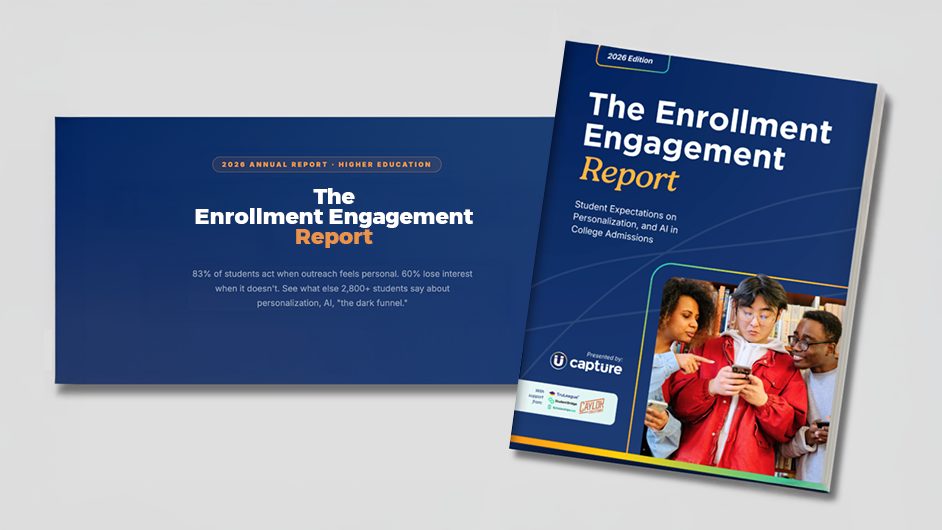
Download the full 2026 Enrollment Engagement Report
The moment enrollment teams often misunderstand
By mid-March, the admissions landscape begins to shift. Acceptance letters have already arrived. Students have options. In many cases, several strong ones. But what should feel like clarity often becomes something else entirely. Students who spent months asking: “Will I get in?” are now asking a much more difficult question: “What if I choose the wrong college?” This shift—from uncertainty about admission to anxiety about decision—has become one of the most critical moments in the student journey. And it sits at the center of new national research exploring how students engage with colleges today.
A national research study on the modern enrollment journey
The 2026 Enrollment Engagement Report: Student Expectations on Personalization and AI in College Admissions surveyed more than 2,800 college-bound high school juniors and seniors navigating the college search process. The study was conducted in collaboration with organizations across the enrollment ecosystem:- Capture Higher Ed
- StudentBridge
- Caylor Solutions
- TruLeague
The “dark funnel” shaping enrollment decisions
Traditional enrollment strategy assumes engagement begins when a student raises their hand. An inquiry form. A campus visit. An event registration. But the research reveals a different reality. More than 53% of students reported applying or requesting information from a college without ever interacting directly with the institution beforehand. Students today spend weeks—sometimes months—researching colleges independently before institutions ever see their name in a CRM. This hidden stage of the enrollment funnel is often referred to as the dark funnel, driven by stealth applicants. During this phase of the student lifecycle, prospective students are actively evaluating:- academic programs
- financial aid information
- campus culture
- student outcomes
- institutional websites and social content
The mid-March decision dilemma
Once admission offers arrive, the dynamic changes quickly. Students are no longer evaluating whether they can attend a college. They are deciding which one they should choose. At first, having options feels empowering. But by mid-March, many admitted students begin experiencing decision fatigue. Programs look equally strong. Marketing messages begin to sound similar. Rankings blur together. Parents, counselors, and group chats add new layers of opinion. Students who once celebrated multiple admissions offers begin to feel something very different: the fear of making the wrong decision. This moment of cognitive overload is where many institutions unintentionally misread the student mindset.
When more information creates more confusion
When admitted students hesitate, institutions often respond with more information. More program comparisons. More campus visit invitations. More feature highlights. More reminders to commit. But when every college appears strong on paper, additional information rarely creates differentiation. Instead, students begin searching for something else. They look for signals that feel more human. Relatability. Authenticity. Connection. This is where human connection begins to determine the final enrollment decision.
The growing influence of peer conversations
One of the clearest insights from the research is the role of peer influence. When students were asked which interactions had the greatest impact during their college search, one stood out clearly: Talking to a current student or alumnus ranked as the most influential interaction at 40%. This placed peer conversations ahead of:- email outreach (37%)
- physical mail (38%)
- college websites (36%)
The authenticity gap in enrollment communication
The research also reveals a growing sensitivity to how institutions communicate. Today’s students interact daily with highly personalized digital platforms—from streaming services to social media feeds. As a result, expectations around personalized student communication are rising. Nearly two-thirds of students believe colleges should understand their interests based on the content they engage with—even before submitting a form. Yet many institutional systems still personalize communication only after inquiry. When communication feels generic, students notice. In fact, the research shows: Nearly 60% of students report a more negative perception when outreach feels AI-generated. Students are not asking institutions to communicate more frequently. They are asking institutions to communicate more meaningfully.
AI in enrollment: useful, but not enough
Artificial intelligence is already influencing how students research colleges. Nearly 47% of students report using AI tools during their college search to gather information or compare institutions. But even as AI becomes part of the discovery process, students continue to prioritize human guidance when making important decisions. In practice, technology accelerates how students gather information — but it does not replace how they build trust. The research shows: More than 80% of students say they still prefer getting answers from a real person when evaluating colleges. And in the early research phase:- 65% prefer speaking with a person about majors and academic programs
- 76% prefer human guidance when asking about campus life
Why human connection matters in the student journey
Across every stage of the enrollment experience, one pattern remains consistent. Institutional communication introduces students to a college. But human proof helps them believe in it. Emails explain programs. Websites highlight opportunities. Admissions materials showcase campus life. But conversations with real students provide something different: Perspective Reassurance Authenticity These interactions strengthen community engagement, reinforce student belonging, and help prospective students imagine themselves as part of a campus community.
What this means for enrollment teams
The challenge is no longer access to information — it’s helping students make a decision. At the point of highest intent, students don’t need more content — they need clarity they can trust. This requires a fundamental shift from:- Information delivery → decision support
- Institution-led messaging → student-led validation
- Late-stage engagement → early visibility into intent
- Identify engagement signals before inquiry
- Enable peer conversations at scale — not manually
- Use behavioral insight to trigger human interaction, not just automated outreach