How to Write a Student Ambassador Job Description

A strong student ambassador job description does more than explain a role. It helps institutions recruit students whose experiences and perspectives can make prospective-student conversations more useful.
At the beginning of a new academic year, that is especially worth considering.
For traditional undergraduate institutions, the students who just arrived on campus still have a relatively fresh memory of what they wondered about, worried about, and struggled to understand during their own college search. Graduate and professional programs may have different start dates and recruitment cycles, but the same principle applies: students closest to the transition can provide valuable perspective on what future students may need to understand.
That makes this a useful time not only to recruit ambassadors, but also to reconsider what you are actually recruiting them to do.
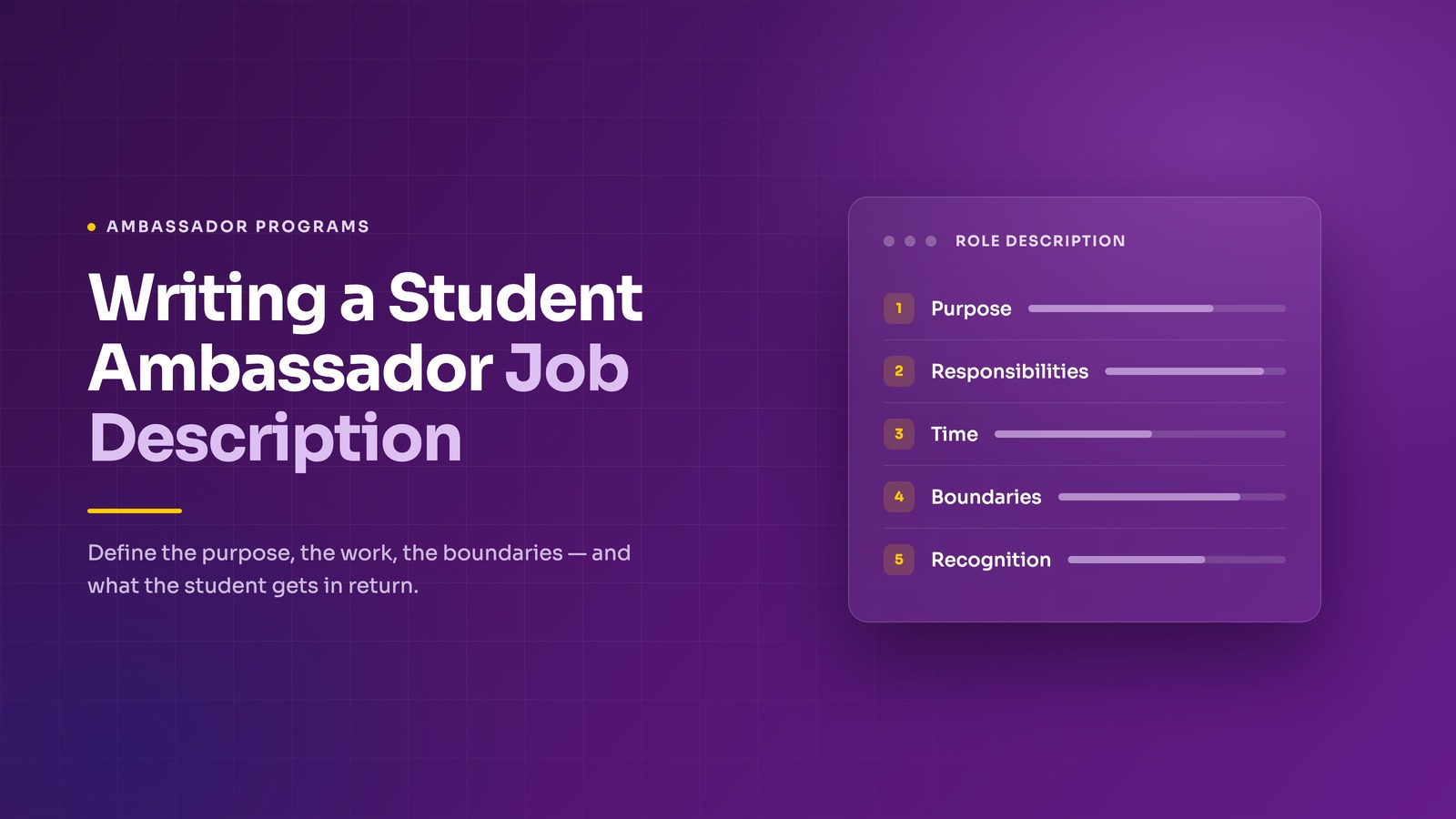
A student ambassador job description should make the purpose of the role clear, describe the work students will actually perform, establish appropriate boundaries, and explain the commitment and recognition involved. It should also reflect the audiences and questions your institution wants its ambassadors to help address.
Start with the purpose, not the title
Before writing responsibilities, define why the role exists.
"Student Ambassador" can mean very different things across institutions. An ambassador might answer prospective-student questions online, participate in admitted-student events, provide campus tours, create content, speak with families, support international prospects, or do some combination of these.
The job description should tell students which of those needs they are being asked to support.
A useful purpose statement might explain that ambassadors help prospective students access candid student perspectives as they evaluate whether an institution or program fits their goals, needs, and circumstances.
That is more meaningful than simply asking students to "represent the university."
Recruit around the questions prospects need help answering
The job description should also reflect the kinds of perspectives your prospective students need access to.
Look at the questions prospects are already asking. Are they trying to understand workload? Campus life? Career preparation? What it is like to transfer? Whether they can balance the program with a job? What arriving from another country is actually like?
Those patterns can help shape both the role and the students you recruit for it.
The goal is not to match every prospect with someone identical to them. It is to build enough range across your ambassador group that prospective students can reach credible people who can speak from relevant experience.
For institutions welcoming a new class this fall, this is also a good opportunity to listen to those newly enrolled students. What do they wish they had understood earlier? Which questions were difficult to answer during their search? What surprised them after enrolling?
Those insights can inform both the ambassador job description and the broader recruitment experience for the next class.
What each section should include
Purpose. Explain why the role exists and how ambassadors contribute to the prospective-student experience. Write this for the student considering the role, not for an internal committee.
Responsibilities. Describe the actual work using concrete language. Depending on the program, that might include responding to prospective-student questions, participating in group conversations or events, sharing personal experiences, creating content, or directing questions to the appropriate institutional resource.
Time commitment. Be transparent about the expected commitment, including whether activity varies during different parts of the recruitment cycle. Avoid assigning a universal number of hours; the appropriate commitment will depend on the program model and expected engagement volume.
Boundaries. Make clear what ambassadors are and are not responsible for, and establish a plan for what they should do when a question falls outside those boundaries. Ambassadors should not have to guess. They should know which questions should be handed off, who the appropriate contacts are, and how to make that connection. Students should feel comfortable saying, "I'm not the right person to answer that, but I can connect you with someone who is."
Questions involving admissions decisions, individual financial-aid circumstances, policy interpretation, or another student's private information should generally be routed to an appropriate staff member. Clear guidance and escalation pathways help ambassadors remain authentic without putting them in the position of interpreting institutional policy or inventing an answer.
Qualifications. Focus on what is genuinely necessary to perform the role: reliability, clear communication, willingness to share personal experience honestly, and comfort interacting with prospective students. Avoid requirements that are unrelated to the actual work or that unnecessarily narrow the range of perspectives represented.
What the student receives. Be clear about compensation, recognition, professional development, references, leadership opportunities, or other benefits associated with the role. If the role is unpaid, say so directly and be thoughtful about what meaningful value or recognition students receive in return. Institutions should also consider whether an unpaid model could limit participation for students balancing work, family, or other financial responsibilities.
If you're writing or revisiting a student ambassador job description, book a conversation with the TruLeague team →
FAQ: Student Ambassador Job Descriptions
How long should a student ambassador job description be? Keep it concise enough that a student can quickly understand the purpose, responsibilities, expectations, and benefits of the role. For many programs, that can be accomplished in roughly a page, but clarity matters more than a particular length.
Should the job description mention payment? Yes. Whether the role is paid, stipend-supported, volunteer, or recognized in another way, students should understand the arrangement before applying.
Does a student ambassador role need HR approval? That depends on the institution and how the role is structured. Paid roles may fall under student-employment or other institutional policies, while volunteer or recognition-based roles may follow different processes. Confirm the appropriate requirements internally before recruiting.
Can the same job description cover undergraduate and graduate ambassadors? Sometimes, but the roles should reflect the audiences they serve. Traditional undergraduate prospects may be asking about campus life, transition, belonging, academic confidence, and the broader college experience. Graduate and professional prospects may be more focused on workload, career alignment, faculty access, program structure, flexibility, and balancing study with work or family responsibilities. If the questions and responsibilities differ meaningfully, the job descriptions should as well.
Should first-year students serve as ambassadors? They can be particularly valuable for certain questions because the application, enrollment, and arrival experience is still recent. More experienced students may be better positioned to speak to other aspects of the student journey. The strongest ambassador group gives prospective students access to a range of relevant perspectives rather than relying on one type of student to answer every question.
About TruLeague
TruLeague helps institutions connect prospective and admitted students with current students, alumni, faculty, and staff throughout the enrollment journey. Through peer engagement, community-building, enrollment-system integrations, and engagement insights, TruLeague helps institutions create meaningful connections while gaining greater visibility into what students need throughout the decision-making process. Learn more at truleague.com.