Building International Student Ambassador Programs: Perspectives from Montclair State and WPI

Two very different institutions share practical lessons on selecting ambassadors, building engagement, structuring incentives, and using peer conversations to strengthen international enrollment.
Montclair State University and Worcester Polytechnic Institute (WPI) approach international enrollment from very different institutional contexts.
Montclair State is a large, comprehensive public university with more than 23,000 undergraduate and graduate students, including approximately 800 international students from 75 countries. WPI is a smaller, STEM-focused R1 research university with a highly international graduate population.
Both institutions brought established ambassador-program experience to the conversation, while their current programs differ in structure and scale. Montclair State currently has 12 undergraduate and graduate ambassadors representing eight countries, while WPI's graduate ambassador program includes 25 current-student ambassadors.
That made their recent AIRC webinar an opportunity to explore the same practical questions from two different perspectives: How do you recruit the right ambassadors? Keep them engaged? Make the program visible to prospective students? And use those conversations to strengthen the broader enrollment strategy?
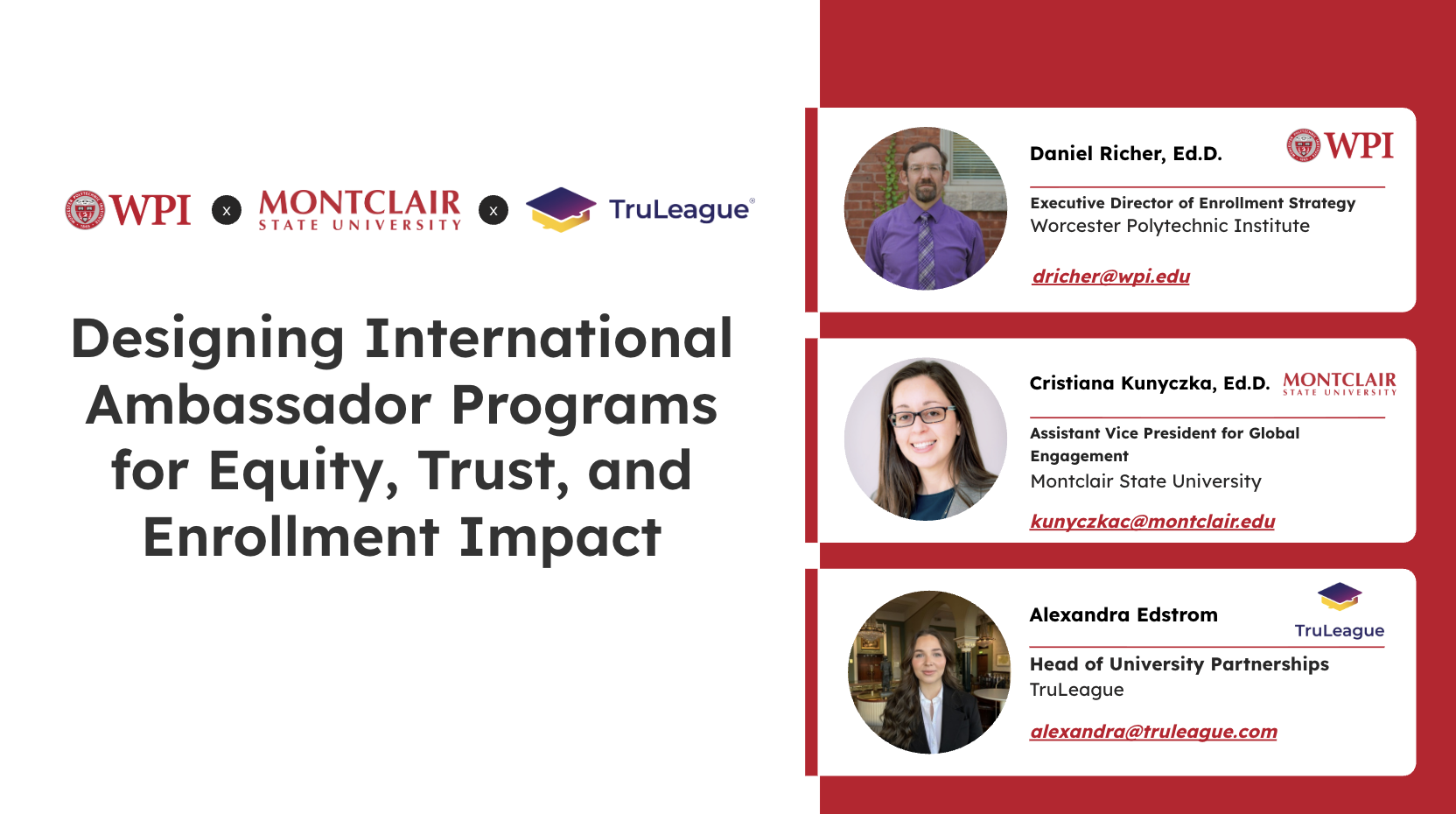
Dr. Cristiana Kunyczka, Assistant Vice President for Global Engagement at Montclair State, and Dr. Daniel Richer, Executive Director of Enrollment Strategy at WPI, joined TruLeague's Head of University Partnerships, Alexandra Edström, to share how their institutions approach ambassador programs and what they have seen through that work.
Looking to build or strengthen your ambassador program? See how TruLeague can help →
Start With What Peer Connection Should Accomplish
At Montclair State, the ambassador program supports several connected goals: giving prospective students access to credible student perspectives, building community before arrival, increasing representation, and helping international students navigate the transition to studying in the United States.
"We want to build community before arrival," Dr. Kunyczka explained. "We can help prospective students form a supportive network early on in the process before they even get here."
WPI approached ambassadors as part of a broader yield strategy. Dr. Richer described a post-pandemic period in which applications increased without corresponding growth in enrollment, creating an opportunity to make current graduate students' experiences and accomplishments more visible.
"We were, I think, humble to a fault," Dr. Richer said. "We were not doing a good enough job amplifying the great work that our current grad students are doing."
The institutional priorities may be weighted differently, but the underlying opportunity overlaps: helping prospective students gain a clearer, more personal understanding of the institution through people already living the experience.
What WPI Saw in Engagement and Enrollment Outcomes
Dr. Richer also shared what WPI has seen in both student engagement and enrollment outcomes.
Across the ambassador program:
- 25 ambassadors engaged with 332 prospective students
- Those students represented 38 countries, 22 U.S. states, and 45 graduate programs
- Prospective students initiated 398 conversations
- More than 3,800 messages were exchanged
The conversations gave WPI more than engagement volume. They also provided insight into the questions prospective students were asking most often, including academics, program offerings, career opportunities, campus activities, and student life. WPI has used those themes to inform its website and prospective- and admitted-student communications.
"If we know this is what they're asking about, let me answer the question before they even get the chance to ask it," Dr. Richer explained.
WPI's enrollment data also showed meaningful differences among students who engaged through TruLeague.
In a case study covering the first 9 months of the partnership, 208 students signed up to chat through TruLeague. Among students who engaged, 43% of international students and 25% of domestic students committed — approximately 2x WPI's yield rate compared with the non-TruLeague pool.
Additional enrollment analyses showed a similar pattern:
- Fall 2025 confirmed enrollment: 20.14% among TruLeague users vs. 7.98% among non-users
- Spring 2026 confirmed enrollment: 34.15% among TruLeague users vs. 13.88% among non-users
Across those two enrollment periods, TruLeague users showed approximately 2.5x higher confirmed-enrollment conversion than non-users.
Dr. Richer identified student ambassadors as an important part of WPI's broader yield work:
"Getting really good, solid, dynamic student ambassadors that have great stories to tell was one of the most impactful things that we did for our yield."
For WPI, the value has been twofold: giving prospective students direct access to current students while also creating engagement and enrollment data the university can use to better understand the student journey.
Build the Cohort Around the Students You Want to Reach
Both institutions emphasized intentional ambassador selection and representation.
Montclair State recruited through social media and email outreach, interviewed applicants, and selected ambassadors with representation across key regions and majors in mind.
"We wanted to have as many students representing different regions as possible," Dr. Kunyczka said.
WPI faced a similar challenge. With some programs and countries much more heavily represented in its graduate population than others, the team did not want its ambassador cohort to reflect only those largest groups.
As Dr. Richer explained, the goal was to help students find someone they had something meaningful in common with.
That does not require an exact match for every prospect. Instead, the cohort should offer enough academic, geographic, and experiential range that students have multiple ways to find a relevant connection.
There Is No Single Incentive Model
Dr. Kunyczka and Dr. Richer also emphasized that compensation and recognition can look different across institutions.
Montclair State chose a volunteer model and plans to recognize ambassadors through events, food, swag, badges, and continued engagement with staff.
At WPI, incentives include a mix of swag, philanthropic motivation, paid opportunities, and LinkedIn badges. The ambassador role can also create professional-development opportunities: students have contributed to research, data analysis, enrollment initiatives, campus tours, and work exploring alumni career outcomes.
Whether an institution uses paid positions, volunteer roles, or another model, the broader principle is the same: consider what ambassadors gain from participating as well as what they contribute.
Promotion Is Part of the Program
Recruiting ambassadors is only half of the equation. Prospective students also need to know how and where they can connect with them.
Montclair State has built visibility for its ambassador program through email, the university website, and social media. Dr. Kunyczka also described plans to expand promotion through ambassador video content and extend those connections into orientation. The goal is to make it increasingly easy for prospective students to find and connect with current students.
"We're trying to find ways as much as possible to make the connection as easy as possible for the prospective student to find our current students and start to have that conversation organically," Dr. Kunyczka explained.
WPI has built ambassador engagement into multiple parts of its enrollment strategy, including its website, communications, campus tours, webinars, and yield events. They have also identified a potential recruitment loop: students who benefited from ambassador conversations as prospects can later become ambassadors themselves.
An ambassador program cannot create much value if students have to discover it on their own. Visibility has to be part of the strategy.
Support Ambassadors Beyond Training
Both institutions described ambassador support as an ongoing responsibility rather than a one-time training exercise.
At Montclair State, training helps students understand the role, communicate professionally, and know when a question should be referred to someone else at the university. Planned monthly events will combine recognition with continued development, including practical exercises around common student questions.
WPI uses regular check-ins, social events, and dedicated staff support. Dr. Richer also described exploring ways for former student ambassadors to stay involved after graduation as alumni ambassadors.
The common principle is structure without over-scripting. Ambassadors need enough preparation and support to communicate confidently while still offering the authentic student perspective prospective students are seeking.
Make Peer Engagement Visible
Peer engagement becomes more useful to enrollment teams when it can be connected with the systems they already use.
Dr. Richer highlighted WPI's Slate integration because TruLeague-engaged students can be identified within the CRM and engagement information incorporated into reporting.
"We can actually report on those things very easily," he explained.
The point is not simply to collect more data. It is to make peer engagement visible enough that teams can learn from it and use it alongside the rest of their enrollment work.
What Institutions Can Take From Their Experience
Montclair State and WPI differ in size, academic focus, and international student populations. Their experiences nevertheless point to several consistent practices:
- Define what you want the program to support, recognizing that belonging, engagement, yield, and retention can reinforce one another.
- Build representation intentionally across the academic, geographic, and experiential differences that matter to students.
- Create value for ambassadors, whether through compensation, recognition, professional development, community, or meaningful experience.
- Plan for visibility. Recruiting ambassadors and making them accessible to prospective students are two different jobs.
- Provide ongoing support without scripting away the authentic student perspective.
- Learn from the conversations and use recurring questions to improve the broader enrollment experience.
- Connect peer engagement to institutional systems and outcomes so its role can be understood alongside other enrollment efforts.
As Alexandra noted during the webinar, peer-to-peer engagement will not solve every enrollment challenge. What it can do is give prospective students access to authentic perspectives while giving institutions another window into what students need as they make their decisions.
For Montclair State and WPI, the opportunity goes beyond simply connecting prospective students with current students. It is about creating the structure for meaningful peer connection — and then learning from what happens next.
If you're building an international ambassador program or looking to strengthen an existing one, book a conversation with the TruLeague team →
About TruLeague
TruLeague helps institutions connect prospective and admitted students with current students, alumni, faculty, and staff throughout the enrollment journey. Through peer engagement, community-building, enrollment-system integrations, and engagement insights, TruLeague helps institutions create meaningful connections while gaining greater visibility into what students need throughout the decision-making process. Learn more at truleague.com.