How Should You Pay Student Ambassadors?

How an institution compensates student ambassadors can shape who is able to participate, what students expect from the role, and how the program is managed.
At the beginning of an academic year, many institutions are recruiting or re-engaging student ambassadors for the enrollment cycle ahead. That makes this a useful time to look at compensation alongside the role itself rather than treating it as an administrative detail after students have already been recruited.
There is no single compensation model that fits every ambassador program. The right approach depends on the responsibilities involved, expected time commitment, institutional policies and budget, and what students are being asked to contribute.
Start with the role before choosing the model
Compensation should reflect the work.
An ambassador who occasionally participates in an admitted-student panel is performing a different role from one who responds to prospective-student messages throughout the week, creates content, attends events, or serves as an ongoing point of contact.
Before choosing a compensation model, define:
- what ambassadors will actually do;
- how frequently they are expected to participate;
- whether there are response-time or availability expectations;
- whether responsibilities fluctuate during the enrollment cycle;
- and what institutional policies apply to paid or volunteer student roles.
Clear expectations make it easier to choose a model that is appropriate for both the institution and the student.
Compensation models to consider
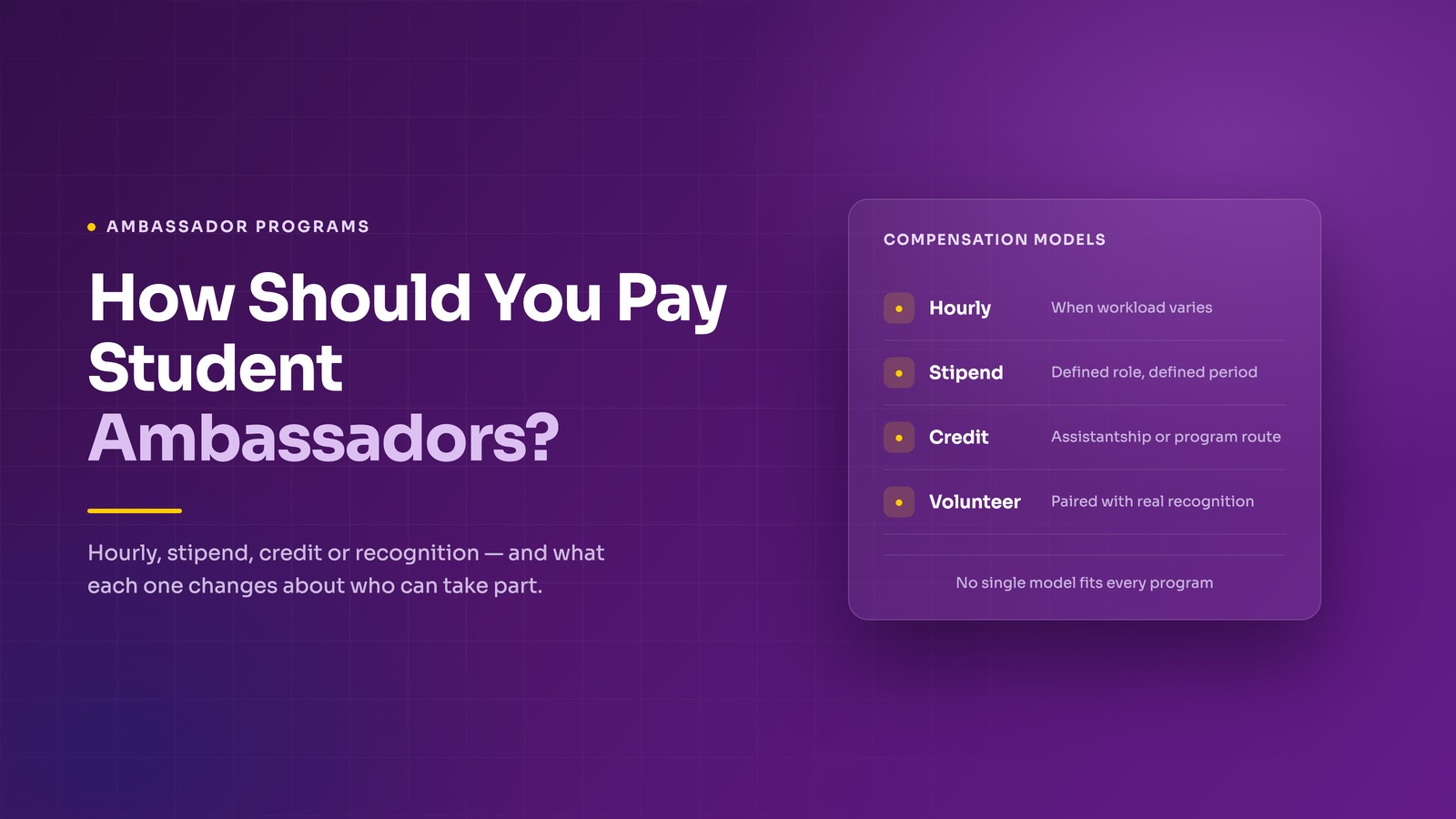
Hourly pay. Hourly compensation can make sense when workload varies or when ambassadors have defined working hours. It also requires an institution to determine how time will be recorded and what activities count as paid work.
Fixed stipend. A stipend can provide predictable compensation for a defined role over a semester, recruitment cycle, or other period. Institutions should be clear about the expected workload so the commitment and compensation remain reasonably aligned.
Scholarship, academic credit, assistantship, or other institutional support. Some institutions or programs may have existing structures that can support ambassador participation. Whether these options are appropriate depends on institutional policy, the nature of the role, and the academic or employment requirements involved.
Unpaid participation with recognition. Volunteer ambassador roles can work well when the commitment is manageable, expectations are clear, and students see meaningful value in participating. Recognition might include references, leadership experience, professional development, digital credentials, events, networking, or other opportunities.
If a role is unpaid, that should be clear from the beginning. Institutions should also consider the expected time commitment and whether the structure gives a broad range of students a realistic opportunity to participate.
Compensation can influence participation
Compensation is not only a budget question. Along with workload, scheduling, recognition, and the nature of the role, it can influence which students are interested in and able to participate.
That matters because ambassador programs benefit from giving prospective students access to a meaningful range of experiences and perspectives.
For example, an institution hoping to include students who balance school with employment, commuting, family responsibilities, or other commitments may want to consider whether the role is flexible enough to make participation practical.
There is no assumption that paid programs are inherently better than volunteer programs. The goal is to choose a structure that fits the work, is transparent with students, and supports the range of participation the institution hopes to achieve.
Consider compensation and recognition together
Compensation and recognition do not have to be treated as alternatives.
Paid ambassadors can still benefit from leadership development, professional experience, references, digital credentials, mentoring, networking, or opportunities to take on greater responsibility. Volunteer ambassadors should likewise be able to identify meaningful value in the experience beyond simply holding the title.
The right mix will vary by institution and by role. A student who participates in a small number of events may experience the commitment differently from an ambassador who responds to prospective students regularly throughout an enrollment cycle.
Whatever the model, students should understand both what is expected of them and what they can expect from the experience.
Set the structure before you recruit
Compensation, recognition, workload, and expectations are best considered before ambassador recruitment begins.
Institutions may need time to confirm budgets, student-employment requirements, payroll processes, academic-credit policies, volunteer guidelines, or other internal requirements. Clarifying those pieces early allows the recruitment message to be transparent and helps students decide whether the opportunity fits their own circumstances.
For institutions recruiting or re-engaging ambassadors this fall, this is also an opportunity to look beyond simply filling open roles. Consider what worked for ambassadors in the previous cycle, where participation was difficult to sustain, and whether the structure of the role makes it possible to involve the range of students and perspectives future prospects may benefit from hearing.
That same review can inform more than compensation. It can help institutions refine the role itself before asking the next group of students to take it on.
If you're deciding how to structure and compensate an ambassador role, book a conversation with the TruLeague team →
FAQ: Student Ambassador Compensation
Do student ambassadors have to be paid? Not necessarily. The appropriate structure depends on the responsibilities involved, applicable laws and institutional policies, and how the role is classified. Institutions may use paid, stipend-supported, volunteer, academic-credit, or other models depending on their circumstances. The important thing is to establish the arrangement clearly before recruiting students.
Can an unpaid student ambassador program work? Yes. Volunteer models can work well when expectations are manageable, participation is meaningful, and students understand the value of the experience. Institutions should be transparent that the role is unpaid and periodically consider whether the workload or structure creates barriers to participation.
What is a reasonable student ambassador stipend? There is no universal figure. Institutions can start by comparing the ambassador role with other student positions involving similar responsibilities, expectations, and time commitments, while following their own compensation policies and applicable requirements.
Should ambassadors be paid per conversation or message? Be cautious about tying compensation directly to message or conversation volume. A structure based primarily on quantity could unintentionally encourage activity rather than thoughtful engagement. If variable compensation is being considered, define clearly what behavior the model is intended to support and whether it aligns with the purpose of the ambassador role.
Should volunteer ambassadors still receive formal recognition? Recognition can be valuable regardless of whether a role is paid. References, professional development, leadership opportunities, digital credentials, networking, and other forms of acknowledgment can help students articulate what they contributed and what they gained from the experience.
Can undergraduate and graduate ambassador compensation models differ? Yes. The role itself may differ. Graduate and professional students may participate through assistantships, program-specific structures, or roles designed around different academic calendars and professional responsibilities. Traditional undergraduate programs may use student-employment, stipend, volunteer, or recognition-based models. Institutions should design the arrangement around the actual responsibilities and context rather than assuming one model should apply across every population.
About TruLeague
TruLeague helps institutions connect prospective and admitted students with current students, alumni, faculty, and staff throughout the enrollment journey. Through peer engagement, community-building, enrollment-system integrations, and engagement insights, TruLeague helps institutions create meaningful connections while gaining greater visibility into what students need throughout the decision-making process. Learn more at truleague.com.